Central Park Landmarks
Bethesda Terrace and Fountain Pedicab Tour in Central Park
Bethesda Terrace is the architectural centerpiece of Central Park, a two-level plaza at 72nd Street where the tree-lined Mall ends and the Lake begins. At its center stands Bethesda Fountain and its bronze Angel of the Waters, one of the best-known sculptures in New York.
Quick facts
- Where
- Mid-park at 72nd Street, at the north end of the Mall, overlooking the Lake and the Ramble
- Completed
- Terrace in 1869; fountain dedicated May 31, 1873
- Designers
- Calvert Vaux (terrace), Jacob Wrey Mould (carved ornament), Emma Stebbins (Angel of the Waters)
- Named for
- the Pool of Bethesda in the Gospel of John
- Materials
- bronze, blue stone and polished granite, plus a Minton tile ceiling in the Arcade
Want to see Bethesda Terrace and Fountain?
Request a booking and tell us where you'd like to go.
History
Calvert Vaux and Frederick Law Olmsted's 1858 plan for the park called for an open-air gathering place at the end of the Mall. Vaux designed the terrace, and his assistant Jacob Wrey Mould carved the ornament on its ramps, balustrades and piers. It was finished in 1869 and was one of the first structures built in the park. Vaux called the fountain plaza the "center of the center," according to the Central Park Conservancy.
The Angel of the Waters was the only sculpture commissioned as part of the park's original design. Sculptor Emma Stebbins, the first woman to receive a major public art commission in New York City, worked on it in Rome from 1861 to 1868. The bronze was cast in Munich and dedicated on May 31, 1873. It celebrates the opening of the Croton Aqueduct in 1842, which brought clean water to the city. The lily in the angel's hand stands for purity, and the four cherubs below represent Peace, Health, Purity and Temperance.
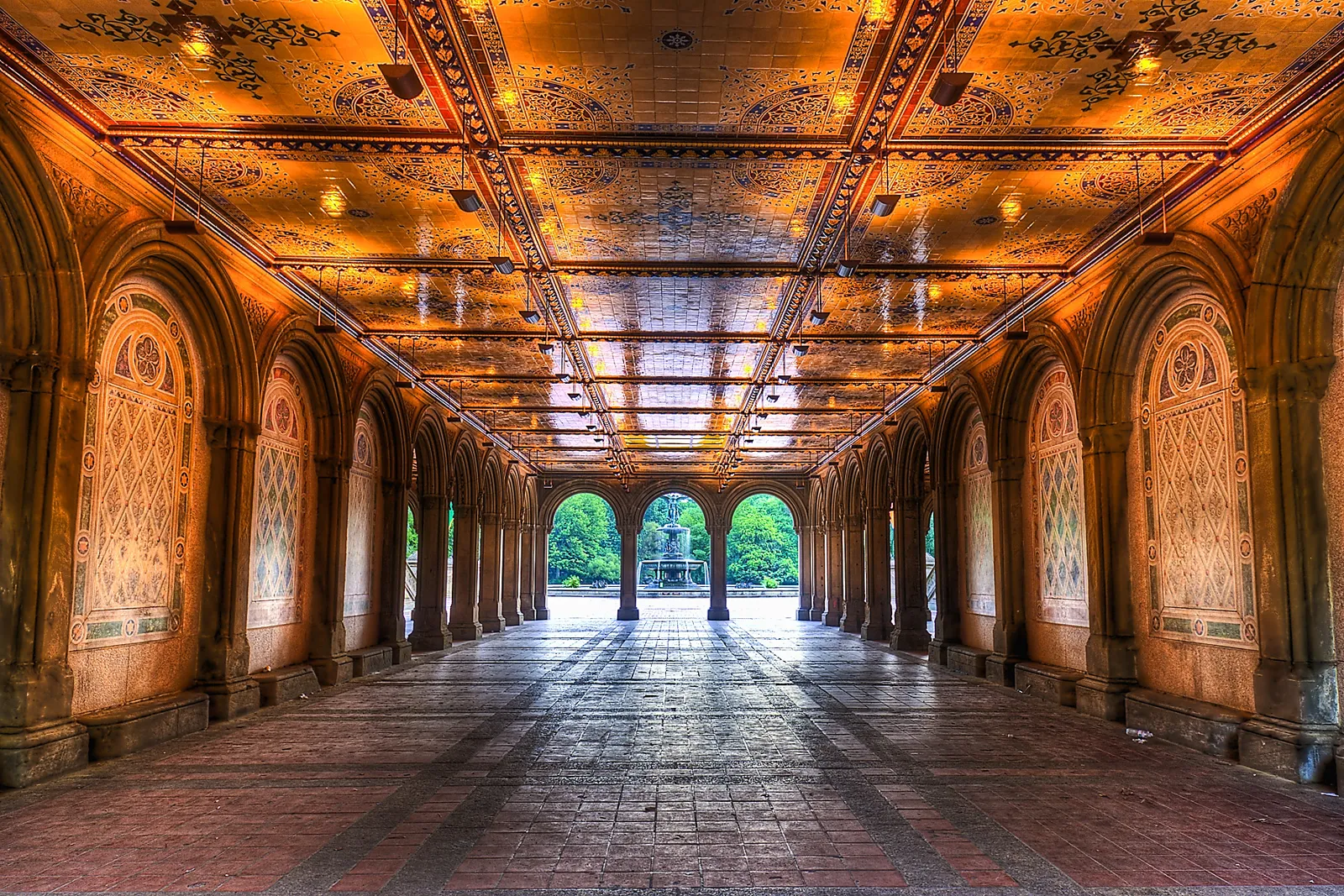
Beneath the Cross Drive, the Arcade has a ceiling made of 15,876 Minton encaustic tiles, handmade in Stoke-on-Trent, England. The Conservancy describes it as the only ceiling of its kind in the world. The tiles were taken down in the early 1980s after water corroded their backing, and the Arcade reopened on March 2, 2007, after a $7 million restoration in which conservators hand-cleaned about 14,000 original tiles.
What to look for
- The Angel of the Waters, framed against the Lake
- The Minton tile ceiling inside the Arcade
- Mould's carved piers and balustrades, which follow themes of time and the seasons, including a rooster for day and an owl and bat for night
- The Lake and Bow Bridge in the view beyond the fountain
Visiting Bethesda Terrace and Fountain
Bethesda Terrace sits between the Mall to the south and the Ramble and Lake to the north, so it is easy to combine with Bow Bridge and Cherry Hill Fountain, both a short ride or walk away. The terrace is a designated Quiet Zone. Conservancy restoration work on the fountain can change what is running at any given time, so it is worth checking the Conservancy's Bethesda Fountain page before you visit.
Frequently asked questions
Who designed Bethesda Terrace?
Calvert Vaux designed the terrace, and Jacob Wrey Mould carved its ornament.
Who made the Angel of the Waters, and when was it dedicated?
Emma Stebbins made it, and it was dedicated on May 31, 1873.
Why is it called Bethesda?
The name refers to the Pool of Bethesda in the Gospel of John, where an angel gives the water healing powers. The fountain also honors the 1842 Croton Aqueduct.
What is special about the ceiling of the Bethesda Arcade?
It is covered in nearly 16,000 Minton encaustic tiles, a type normally used on floors.
Sources
Nearby landmarks
← All landmarksBook Your Central Park Tour
Ready to see the terrace for yourself? Choose a pedicab tour and send us your preferred date and time.
Request a Booking